

In 1755, capiz shells started appearing in church and home windows across the Philippine archipelago, cut into thin panes and set into wooden frames to filter tropical light into a pearl-toned glow. Nobody designed this for beauty. They designed it for ventilation in a climate that punishes sealed windows, and the side effect became one of the most recognizable textures in Filipino domestic space.
That same logic, using what the islands offer to shape how light and history move through a room, is what makes Filipino heritage wall art work in a home rather than just hang on a wall.
Philippine visual heritage runs through three overlapping traditions: indigenous craft from groups like the Ifugao and T'boli, Spanish colonial religious and decorative work introduced from the 16th century, and the American-period painting that produced Fernando Amorsolo's pastoral canvases. Decorating with this heritage means choosing from a layered archive, not a single look.
This guide covers how to bring that archive into a home with intention: which tradition a piece belongs to, which artists defined which eras, and where a print earns its wall.

Filipino Heritage Wall Art and the Three Traditions Behind It
A piece's tradition determines its visual language before it determines anything about decor.
The oldest tradition is indigenous. Among the Ifugao of the Cordilleras, the bulul, a carved rice guardian figure, represented deities invoked for a bountiful harvest. The National Museum of the Philippines holds bulul figures in its National Ethnographic Collection alongside hipag war deities, citing them as central to Ifugao ritual life rather than display. The T'boli of Mindanao wove t'nalak from abaca fiber, its patterns drawn from the weaver's dreams and treated as sacred. The Maranao carved okir, a flowing pattern shaped by Islamic art, into houses, boats, and weapon handles. None of these forms existed apart from daily life. Carvers and weavers passed them hand to hand across generations, not through museums.
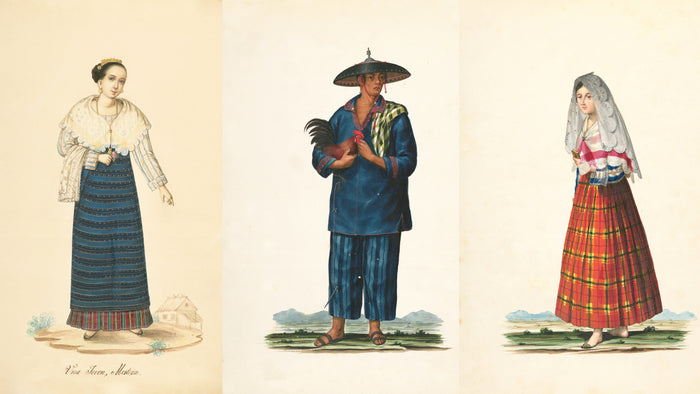
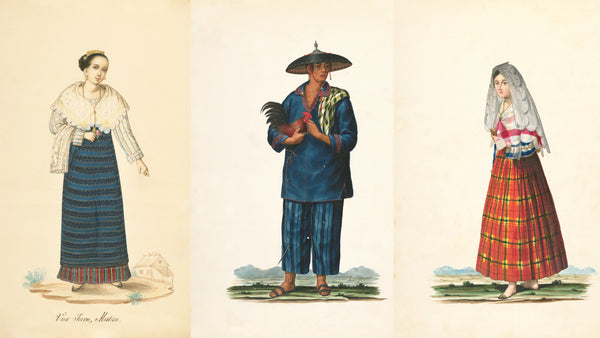
Spanish colonization, beginning in the 16th century, brought Baroque architecture, religious iconography, and European painting convention into that existing visual world. Filipino artists absorbed these forms and reworked them. This period produced what collectors now call Philippine historical maps, botanical illustrations, and Tipos del País portraiture: colonial-era life documented through both Spanish instruction and native hands.

The American period that followed brought Western-style painting and theater, producing an East-West fusion still visible in Philippine galleries today. Together, these three traditions form the entire range available to anyone decorating with Filipino heritage wall art. Knowing which one a piece belongs to changes where it should hang and what story it tells once it does.
That history has names attached to it, and the names matter more than the categories.
The Artists and Eras That Shaped the Visual Archive
Two names anchor the 19th-century chapter. Juan Luna, born in 1857, won the gold medal at the 1884 Madrid Exposition of Fine Arts for Spoliarium. Félix Resurrección Hidalgo won silver at the same exposition for Las Vírgenes Cristianas Expuestas al Populacho. The wins arrived together and landed as a single message: Filipino artists could compete on European terms while painting subjects rooted in Philippine and colonial history. The Ilustrados, the educated Filipino class pressing for reform under Spanish rule, celebrated both medals as proof of that point.
Luna died in Baguio on December 7, 1899. By then his generation's work, alongside the maps, botanical plates, and portrait collections produced throughout the Spanish colonial period, had already become the core of what is now reproduced as archival fine art prints.
The American period brought a different register. Fernando Amorsolo, working from 1892 to 1972, became known for pastoral scenes like Rice Planting, rendered in the warm backlight that defined his career. Carlos "Botong" Francisco, active until 1969, painted Filipino history at mural scale, including the Katipunan uprising. Both worked in a period when Philippine art absorbed Western technique while staying rooted in local subject matter.
A Tipos del País portrait, a colonial-era map, and a botanical plate each carry a specific period and a specific maker. None of them are an interchangeable "antique" look. Each one asks a different question about where it belongs in a home, which is the question worth answering before the question of decor.
 Why Heritage Pieces Belong in a Modern Interior
Filipino interior design has depended on tropical materials for centuries: bamboo, rattan, abaca, coconut shell, paired with open layouts and wide windows built for cross-ventilation. The bahay kubo, the original vernacular house, ran entirely on this logic. A pointed roof. An elevated silong space underneath. Walls open enough to move air freely through the structure. The bahay na bato, which emerged in the 19th century, added a stone foundation and Spanish architectural elements without abandoning the ventilation principles the bahay kubo had already solved.
Capiz shell windows joined this vocabulary from 1755 onward. The National Museum of the Philippines cites capiz windows as a defining feature of bahay-na-bato structures built throughout the Spanish colonial period, filtering light into a soft glow without blocking the airflow the house depended on. Colonial period, filtering light into a soft glow without blocking the airflow the house depended on. Heritage wall art follows the same logic today: pieces that work with natural light and open space instead of competing for attention against them.
A Philippine art print interior built on this principle favors a small number of well-chosen archival pieces over a dense gallery wall. A single Tipos del País print near a stained-glass window. A botanical plate beside a capiz-paneled door. Each placement lets the architecture and the artwork carry each other rather than crowd each other out.
Family heirlooms already work this way instinctively. An antique inherited from a grandparent carries weight in a Filipino household because it ties a room to one specific person and one specific past. A well-chosen archival print does the same work for someone building a home from nothing, anchoring a space in a documented history instead of a passing trend. Republic Act 10066, the National Cultural Heritage Act, became law on March 26, 2010, specifically to support this kind of preservation as national priority. Decorating with archival Philippine art participates in that same effort, one wall at a time.
That national framing has a calendar attached to it.
National Heritage Month and the Calendar Case for Heritage Decor
Every May, the Philippines observes National Heritage Month under Presidential Proclamation No. 439, signed by President Gloria Macapagal-Arroyo on August 11, 2003. The National Commission for Culture and the Arts leads the celebration each year under a different theme. The 2023 theme centered on weaving and shared stories. The designation gives heritage decorating a fixed moment on the calendar, a reason to finally frame the print that has been sitting in a drawer.
The timing also matches how heritage pieces actually arrive in a home: gradually, one object at a time, rather than as a single coordinated purchase. A map print bought one year. A botanical plate the next. A Tipos del País portrait added later, once the right wall presents itself. Treating Filipino heritage wall art as an ongoing collection rather than a one-time decision mirrors how the three traditions themselves built up over centuries: layer by layer, never all at once.
May gives a homeowner a useful prompt. Everyone else can use the underlying idea instead: heritage art rewards patience, not urgency.
Building a Home Around Philippine Heritage Today
A home built around Philippine heritage art does not need a museum's hush. It needs one or two pieces chosen with the same care that shaped the bulul carved for a Cordillera household or the t'nalak woven from a dream. A historical map near a reading chair. A botanical plate in a hallway that catches afternoon light. A portrait from the Tipos del País collection - Maynila Archive above a console table. Each placement gives the work room to be seen rather than simply present.
The three traditions behind this archive, indigenous craft, Spanish colonial documentation, and American-period painting, exist today as archival fine art prints, reproduced with the same attention to detail the originals demanded. Maynila Archive draws from that full range, restored and printed for homes that want a real connection to Philippine visual history rather than a decorative stand-in for it.
Explore the full collection here:
Maynila Archive Collections.

Philippine Heritage Art Collection
Available as a Fine Art Print
Maps, botanical plates, and Tipos del País portraits from the Spanish colonial and American periods, carefully restored and reproduced as museum-quality fine art prints on archival paper. Each piece carries its original period and maker, suited to a single wall rather than a crowded one.
Made to order for collectors and heritage enthusiasts.
Visit our shop:
Maynila Archive Collections


