

José Rizal and Philippine Visual Culture: How the National Hero Shaped Filipino Art
On June 25, 1884, José Rizal stood before a gathering of Filipino expatriates at the Restaurant Inglés in Madrid and told them that Juan Luna and Félix Resurrección Hidalgo had provided "fresh proof of racial equality." Luna had just won the gold medal at the Madrid Exposition of Fine Arts for Spoliarium, his monumental canvas of dead gladiators being dragged through a Roman arena. Hidalgo had won the silver for Las Vírgenes Cristianas Expuestas al Populacho. Rizal was twenty-three years old and three years from publishing his first novel. José Rizal Philippine art history begins here, not in a museum catalog but in a toast, where the man who would become the national hero first argued publicly that Filipino artists could define what the nation was capable of.
The speech did more than celebrate two painters. Rizal interpreted Luna's Spoliarium as an allegory of oppression and suffering, writing that it embodied "humanity in severe ordeal, reason and idealism in open struggle with prejudice, fanaticism, and injustice." He was already building the argument in prose, sculpture, and speech that he would formalize in Noli Me Tangere three years later.

José Rizal, Philippine Art History: The National Hero as Practicing Artist
Rizal's relationship to Philippine visual culture was not simply that of a critic or admirer. He painted, sketched, and carved throughout his life, and his visual output is now documented as part of the national heritage alongside his novels and letters.
He produced 56 sculptural works in wood, clay, and plaster. Only 18 are known to survive. Among those, The Triumph of Science over Death shows a nude female figure standing on a skull, holding a torch aloft, gifted to his friend Ferdinand Blumentritt. Prometheus Bound, completed in 1890 and also given to Blumentritt, places Rizal directly within the European classical tradition he encountered during his years abroad. La venganza de la madre, a dramatic group of a dog biting a crocodile holding a puppy, is now designated a National Cultural Treasure. These are not casual sketches. They are completed works by someone who understood sculpture as a medium for ideas about nature, myth, and colonial power.

His drawings include a profile wood carving of Josephine Bracken and architectural studies such as his sketch of the Gendarmenmarkt in Berlin. Together, these images form a visual diary running parallel to his letters and published writing.
The significance of Rizal as a visual artist is that he operated in the same media that would later be used to memorialize him. He understood from the inside what images could carry, which is precisely why his speech about Spoliarium went so far beyond simple praise.
The Spoliarium Speech and What It Founded
Rizal's June 25, 1884 speech is one of the foundational documents of Philippine art criticism, the moment when art was explicitly and publicly tied to national identity and political aspiration. The argument he made at the Restaurant Inglés was not only that Luna and Hidalgo had excelled. It was that their excellence proved something about the Filipino people that no colonial authority could dismiss.
Spoliarium now hangs at the National Museum of the Philippines, where the Spoliarium Hall is named in its honor. The painting measures approximately 4.22 meters by 7.67 meters and remains the largest work in the museum's fine arts collection. Seeing it in person makes Rizal's response more legible: this was a painting that demanded a response matching its ambition, and Rizal provided one.

Scholars have noted that Rizal was so moved by Spoliarium that it shaped his approach to Noli Me Tangere, published in Berlin in 1887. He described his novel as a literary counterpart to Luna's canvas, a written indictment of colonial oppression that operated through character and narrative the way Luna's painting operated through scale and color. The two men worked in parallel, using different media to build the same argument.
Hidalgo's Las Vírgenes Cristianas, though less frequently discussed, received equal attention in Rizal's speech. The dual Filipino triumph at the 1884 Madrid Exposition was a coordinated cultural event, and Rizal immediately understood its significance for the ilustrado class watching from Manila and Madrid alike.
Noli Me Tangere in Images: How Rizal's Novels Became Philippine Visual Culture
Rizal's novels did not remain purely literary objects. They became visual ones. The first edition of Noli Me Tangere, published in 1887 in Berlin, included illustrations, and later editions were paired with artwork by Filipino artists. Juan Luna contributed 21 illustrations to an 1892 edition connected to the novel, visually fixing its characters and scenes in the public imagination of the ilustrado class.

For the Philippine national hero visual culture tradition, the pairing of Rizal's text with Luna's images matters because it shows how prose and image worked together to create a shared visual vocabulary for discussing colonial injustice and emerging national identity. The images gave faces to characters readers had constructed in their minds, and those images circulated among communities that shared both the reading and the looking.
The Philippine heritage print collection at Maynila Archive draws from this same tradition, where historical documents and colonial-era illustrations carry cultural arguments that prose alone cannot make.
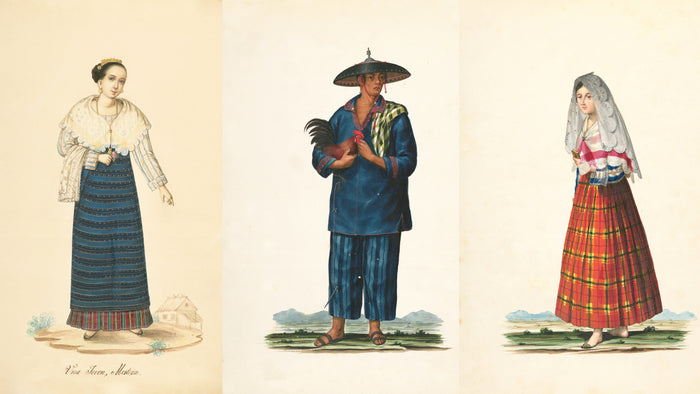
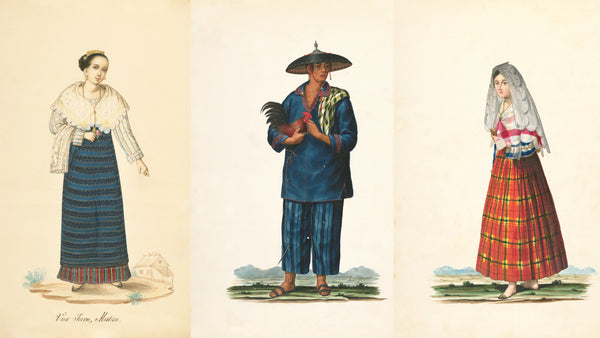
For Filipino collectors and members of the diaspora, the connection between Rizal's written work and its visual companions confirms that Philippine national culture was always multi-media, built from images as much as from words. The Tipos del País watercolors of the same period, by Lozano, Asuncion, and Domingo, were being produced alongside Rizal's writing and shared the same ilustrado audience. The National Commission for Culture and the Arts cites this convergence of text and image as central to how Rizal's legacy was constructed and sustained across generations.
The Monument Problem: One Image Across a Thousand Plazas
The most visible way Rizal shaped Philippine visual culture is through the proliferation of monuments. The first Rizal monument was erected in Daet, Camarines Norte, with construction beginning on December 30, 1898, the second anniversary of his execution, and completed in February 1899. Aguinaldo's decree declaring December 30 a national day of mourning in the "Free Philippines" drove its construction. A 1961 marker from the Philippine Historical Committee formally recognized it as the first Rizal monument in the country.

Under the American colonial government, the Rizal monument tradition was institutionalized at a national scale. On September 28, 1901, the Philippine Commission passed Act No. 243, reserving land in Luneta for a national monument and allowing public subscriptions to fund it. An international design competition followed. Swiss sculptor Richard Kissling (1848-1919) won with his design of a bronze figure of Rizal in a long coat, holding a book, with allegorical figures and a granite obelisk. The monument was unveiled on December 30, 1913. It also serves as Rizal's tomb and as the Kilometer Zero marker for road distances across the country.
Scholars studying the American promotion of Rizal monuments have found that American authorities preferred Rizal to more militant revolutionary figures because his image could support a narrative of peaceful reform and cultural assimilation. As the International Institute for Asian Studies argues, the standard pose, Rizal in a long coat holding a book, was replicated in virtually every municipal plaza across the archipelago, embedding a single, controllable image of the hero into everyday public space. That replication produced the most extensive public art program in Philippine history.
What the Hero's Image Carries Now
Rizal was executed on December 30, 1896, at Bagumbayan, the field that would later be renamed Rizal Park. He was thirty-five years old. The 56 sculptures, the paintings, the drawings, and the speech at the Restaurant Inglés were all produced in less than four decades that also included a medical degree, two major novels, political organizing across two continents, and exile in Dapitan.
The bronze figure in Luneta does not contain all of that. No monument does. What the archival record of Rizal's visual practice preserves is a more complicated person: someone who carved wood and modeled clay, who stood before a friend's painting and wrote the most politically consequential art criticism in Philippine history, who understood that images carry arguments that prose sometimes cannot make alone.
The figure in a long coat holding a book, reproduced in a thousand plazas, is one image. The man who gifted Prometheus Bound to Ferdinand Blumentritt and called Spoliarium a cry against oppression was something harder to summarize and harder to put on a pedestal.
Philippine Visual Heritage Collection
Available as a Fine Art Print
Colonial-era prints, maps, and Tipos del País watercolors from the same period when Rizal delivered his 1884 speech honoring Luna and Hidalgo, carefully restored and reproduced as museum-quality fine art prints on archival paper. Each print documents the visual culture that Rizal interpreted, criticized, and helped define.
Made to order for collectors and heritage enthusiasts.
Visit our shop: Maynila Archive Collections


