

On December 6, 2023, UNESCO inscribed Aklan piña handloom weaving on its Representative List of the Intangible Cultural Heritage of Humanity. The weavers of Aklan, on Panay Island in the Visayas, extract individual filaments from the leaves of the Red Spanish pineapple by hand, knot them into thread, and weave the resulting fiber into a cloth so fine it is described as woven air. For Filipinos abroad searching for a Filipino art print gift or a heritage object that carries genuine cultural weight, that inscription is a useful reference point. The most meaningful gifts from the Philippines connect the receiver to a documented tradition with a verifiable history, not a decorative style assembled for a tourist market.
This guide covers the heritage objects that carry that connection most clearly: from textile traditions with pre-colonial roots to the archival prints that document Philippine visual history across four centuries.

What Makes a Filipino Art Print Gift Different from a Souvenir
A souvenir marks that someone was somewhere. A heritage object carries evidence of what that somewhere was, who lived there, what they made, and how they understood their world. For Filipinos living abroad, that distinction determines what a gift can do across distance.
Philippine textiles illustrate this most clearly. The National Museum of the Philippines documents weaving traditions across the archipelago that served social and ritual purposes far exceeding decoration. Textiles marked social rank. They functioned as bride wealth in marriage negotiations. They served as offerings in healing and harvest rituals and appeared in burial practices across multiple ethnic communities. A handwoven textile sent from the Philippines to a family member abroad carries that layered history in its structure, whether or not the recipient knows the full scope of what the object represents.

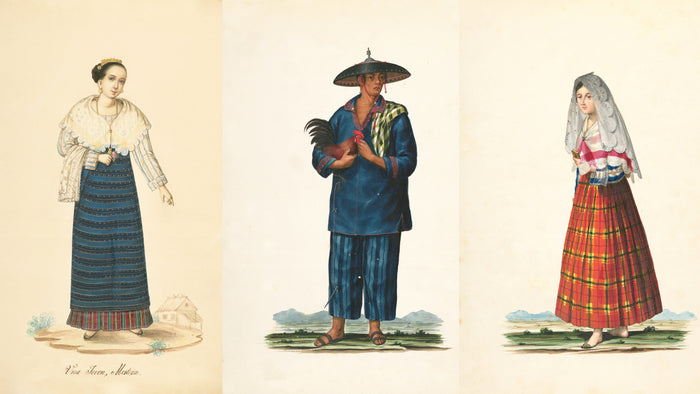
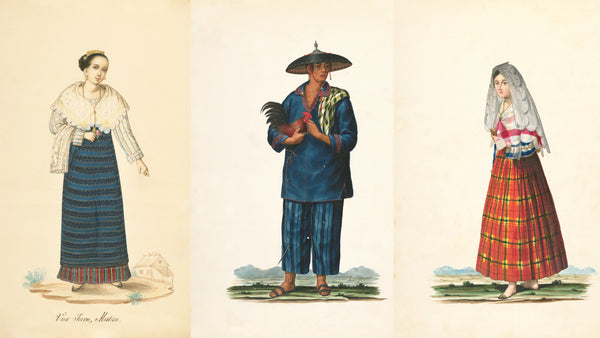
Archival prints operate on a parallel principle. A Filipino art print gift drawn from the 19th-century Tipos del País tradition, produced by artists including José Honorato Lozano and Justiniano Asunción, records colonial-era Philippine society with a specificity that no contemporary item can replicate. Lozano's watercolors documented the dress, occupations, and social positions of people living in Manila and the surrounding provinces during the Spanish colonial period. Each figure is named, classified, and rendered with the observational precision of a primary source.
The Philippine heritage gift that carries the most meaning is always the one with the most specific story behind it, and the story that connects to a documented place and time.
Piña, Inabel, and the Textile Traditions Behind the Object
Piña cloth is produced from fibers extracted from the leaves of the Red Spanish pineapple variety, a process requiring the hand-pulling of individual filaments and knotting them into thread before weaving begins. The resulting fabric is lightweight, translucent, and formally associated with the Barong Tagalog, the embroidered shirt that serves as the Philippine national formal attire for men. The UNESCO intangible heritage inscription recognized piña weaving as a source of identity, creativity, livelihood, and social empowerment for the communities that produce it, particularly the women weavers of Aklan province.

The inscription also noted that piña weaving transmits through family lineages and through Schools of Living Traditions, a formal mechanism the Philippine government uses to sustain endangered cultural practices. A piece of piña cloth is not simply a product. Each piece records a specific chain of instruction passing from one generation to the next, in a specific place, using a plant material that grows in that region.
Inabel, the traditional textile of the Ilocos region in northern Luzon, has a parallel history. The National Commission for Culture and the Arts, established under Republic Act No. 7356, specifically supports the documentation and preservation of living cultural traditions including weaving. Inabel uses geometric patterns and natural dye traditions documented across both the pre-colonial and Spanish colonial periods. Distinct weave structures including pinilian, binakul, and ikat are each tied to specific Ilocano communities, carrying a visual vocabulary traceable across centuries of Philippine material culture.
A Philippine heritage gift built around textile is built around a documented practice with a verifiable chain of transmission.
Why Archival Prints Work as Heritage Gifts for the Filipino Diaspora
Filipinos living and working abroad number in the millions. For this community, a Filipino diaspora gift guide that takes heritage seriously must account for what a gift is asked to do across thousands of kilometers. Food is consumed. Craft is used and eventually worn out. An archival print stays on a wall for decades, and the wall it occupies becomes part of how a household defines its relationship to Philippine history.
The Tipos del País illustrations are the strongest category of archival print for this purpose. Produced during the Spanish colonial period and held in institutional collections including the National Museum of the Philippines, these watercolors record specific social types, occupations, and ethnic communities present in the Philippines before the major disruptions of the late 19th century. A print of India de Manila by José Honorato Lozano shows a specific woman in specific dress in a specific social position. The image is a primary document, not a decorative interpretation.

Historical maps carry equal weight. The 1734 Murillo Velarde map, engraved in Manila by Nicolás de la Cruz Bagay, was cited as legal evidence in the 2016 Permanent Court of Arbitration case concerning Philippine maritime territory. An archival reproduction carries its full history into a domestic space, including the fact that Bagay signed his work "Indio Tagalo" on the copper plate that produced every printed copy. That biographical detail travels with the print.
Maynila Archive brings this documented visual history into homes suited to the Filipino diaspora's particular relationship to distance and belonging.
The Colonial Archive and What It Preserves
Philippine visual history from the Spanish colonial period survives in fragmentary form. The Battle of Manila in February and March of 1945 destroyed a significant portion of the built archive, including private collections, institutional holdings, and the physical fabric of neighborhoods documented in prints and photographs. What survived came through overseas institutional collections held by the Library of Congress and the Biblioteca Nacional de España, and through the holdings of families who evacuated before the fighting reached their districts.
The Tipos del País tradition survived because its practitioners and patrons distributed copies across multiple collections. Lozano produced his watercolors primarily as commissioned album works for Spanish colonial officials and foreign visitors, which meant copies left the Philippines and entered European and American collections during his lifetime. Asunción's work circulated similarly. The prints that survive today sit in institutional archives across three continents, and their reproduction as art print gifts Philippines collectors and diaspora buyers now acquire makes that distributed archive accessible in a new form.
The Murillo Velarde map survived the loss of its original copper plates, which British forces seized during the 1762 occupation of Manila, because enough printed copies had already circulated. A donated copy was formally received by President Ferdinand Marcos Jr. at Malacañang Palace in December 2024, fulfilling a Deed of Donation from Mel Velasco Velarde, who had acquired the map at a Sotheby's London auction in November 2014 for £170,500.

These are not simply old images. They are documents that have moved across continents, survived occupations and destructions, and been cited before international tribunals.
What the Gift Carries That Nothing Else Can
A Filipino art print gift placed on the wall of a house in London, Toronto, or Dubai asks a question every time someone looks at it. Not the decorative question of what color scheme it matches, but a historical one: who made this, when, where, and what were they documenting?
The Tipos del País portrait asks who this person was and what their life looked like in a city that no longer exists in the form the artist recorded. The Murillo Velarde map asks how an archipelago understood its own geography nearly three centuries before the modern states that now dispute its waters existed. The colonial-era view of Escolta or the Parian Gate asks what Manila looked like before February 1945.

For Filipinos abroad building homes that carry a genuine relationship to Philippine history, archival prints offer the most durable answer. The chain of custody that runs from a Tagalog engraver in 18th-century Manila, or a watercolorist in 19th-century Intramuros, to a wall in a Filipino household on the other side of the world remains intact.
Philippine Heritage Art Collection
Available as a Fine Art Print
Tipos del País portraits by José Honorato Lozano and Justiniano Asunción, colonial-era maps including the 1734 Murillo Velarde engraved by Nicolás de la Cruz Bagay, and archival views of pre-war Manila, carefully restored and reproduced as museum-quality fine art prints on archival paper. Each print is a primary document, not a decorative reproduction.
Made to order for collectors and heritage enthusiasts.
Visit our shop:
Maynila Archive Collections


