

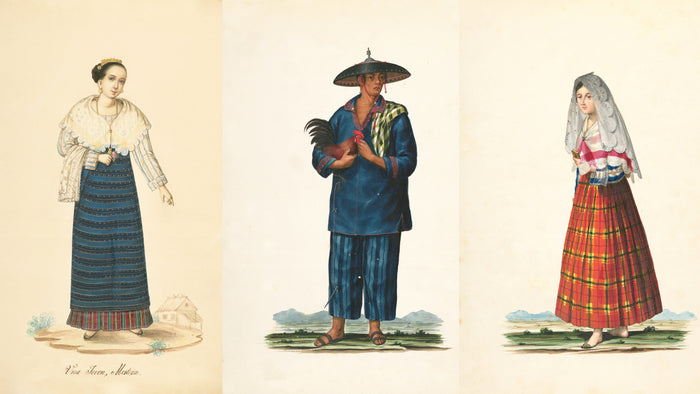
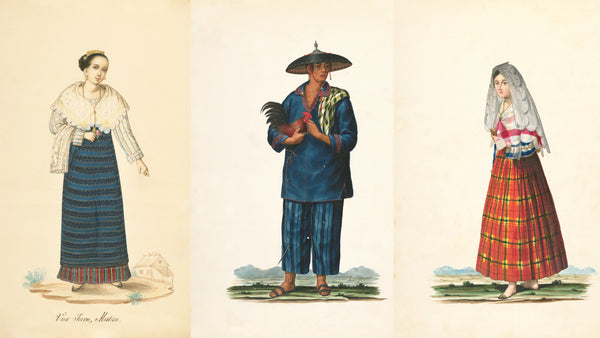
A single watercolor. A nameless figure. An entire society captured in the fall of a fabric, the angle of a hat, the weight of a tool.
Tipos del País, literally translated as "Types of the Country," are a genre of miniature watercolor paintings produced in the Philippines during the 19th century. Each plate depicts a different inhabitant of the archipelago: a Chinese merchant, a Spanish mestiza, an indio laborer, an ilustrado gentleman. Together, they form one of the most complete visual records of colonial Philippine society ever assembled.
For historians, they are primary documents. For collectors, they are rare treasures. For anyone who cares about Philippine visual heritage, they are irreplaceable.

Manila in the 1800s: The World That Produced Them
To understand Tipos del País, you need to understand the Manila that produced them.
By the early 19th century, the Philippines had begun opening to international trade. Foreign merchants, travelers, and colonial administrators were arriving in greater numbers, and they wanted something to take home. Religious imagery had long dominated Philippine painting. But secular demand was growing. Visitors wanted pictures of the place, its people, its textures. The Tipos del País filled that gap.
As noted by the National Commission for Culture and the Arts, the second half of the 19th century saw a marked increase in demand for non-religious souvenirs as travel within the Philippines improved. Tipos del País emerged directly from that demand: visual catalogues of a society in motion.
The colonial Philippines was a deeply stratified world. Spanish-born peninsulares occupied the top of the social hierarchy. Below them: insulares (Philippine-born Spanish), Spanish mestizos, Chinese mestizos known as sangley, ilustrados, and at the base, the native indios. Every layer had its dress, its tools, its posture. The Tipos del País recorded all of it with careful, deliberate precision.
Textile merchants used the albums as visual catalogues. Wealthy travelers brought them home as souvenirs. Elite Filipino families commissioned them as documentary keepsakes. They circulated widely in Europe and the Americas, a window into a world most outsiders had never seen.

The Artists Behind the Archive
Three names define the canon of Tipos del País: Damián Domingo, José Honorato Lozano, and Justiniano Asunción.
Damián Domingo (ca. 1796–1834) is widely regarded as the father of Philippine painting. Born in Tondo, Manila, this Chinese-Filipino mestizo began his career painting miniature portraits and religious imagery before pioneering the Tipos del País genre. In 1821, he established the first Philippine art academy in his own home, an institution that, according to Wikipedia, was possibly the first of its kind in all of Asia to teach Western techniques including foreground, middle-ground, and background perspectives.
Domingo's Tipos del País albums are extraordinarily rare today. Only three complete albums are known to exist. One, a fully signed collection dated between 1827 and 1832, now resides at the Newberry Library in Chicago. In 2019, a single signed plate from the series, Un Indio Noble de Manila, sold at Leon Gallery in the Philippines for PHP 3.74 million, becoming the most expensive work by the artist ever sold internationally.
José Honorato Lozano (1821–1885) carried the genre into its fullest expression. The son of a Manila Bay lighthouse keeper, Lozano grew up in Sampaloc and became what scholars at Mapping Philippine Material Culture describe as one of the "master chroniclers" of mid-19th century Philippines. His plates are distinguished by luminous color, meticulous detail, and deep attention to fabric and dress. He also developed the related genre of letras y figuras, compositions where human figures and scenes are arranged to form the letters of a name, producing some of the most visually inventive works in the Philippine colonial canon.

Justiniano Asunción (1816–1901) trained under Domingo's influence and became a prolific producer of Tipos del País watercolors. His figures, mestizas in piña cloth, indios in baro't saya, Chinese merchants in trade dress, extended the documentary range of the genre deep into the latter half of the century.

All three worked primarily in watercolor and gouache on paper, in small, finely detailed formats suited to the miniature painting tradition. Their works were typically produced in series or albums, sold to foreign collectors and Manila's elite alike.
How to Read a Tipos del País Plate
A Tipos del País plate is not simply a portrait. It is a document.
Every visual element carries information. Fabric signals class. The quality of a man's camisa told you whether he was a laborer or a merchant. Headwear indicated regional origin: a salakot woven one way meant something different from one woven another. Accessories confirmed occupation, whether a fishing basket, a bundle of trade goods, or a set of weighing scales.
The figures are typically depicted full-length, isolated against a minimal background, annotated with a Spanish-language caption identifying the "type." Chino Comerciante (Chinese Merchant). India de Manila (Native Filipina of Manila). Mestizo de Sangley (Chinese-Filipino Mestizo). The captions function as ethnographic labels, organizing a complex, multicultural society into legible categories for an outside audience.
According to Wikipedia's entry on Tipos del País, the genre developed in direct response to increasing demand from tourists, ilustrados, and foreigners seeking souvenirs and decorations that captured local life. The images were, in that sense, simultaneously art, commerce, and anthropology.
Reading them today requires holding that tension carefully. They were produced within a colonial system, for a largely foreign market. The categories they used, indio, mestizo, peninsular, were the categories of colonial hierarchy. And yet within those categories, the artists recorded something true: how people dressed, how they moved, what they carried, what their daily world looked like. That documentary precision is what makes them irreplaceable.

The Decline and the Rediscovery
By the mid-to-late 19th century, Tipos del País had begun to fade. Photography arrived in the Philippines and gradually replaced the hand-painted souvenir as the preferred medium for visual documentation. Tastes shifted. The genre wound down.
What survived scattered into private collections across the Philippines, Europe, and the Americas, often uncatalogued, unattributed, or misattributed for generations.
The rediscovery has been gradual but significant. In 2025, a group of 16 Tipos del País watercolor paintings was identified by the Victoria and Albert Museum in London among its existing holdings. As reported by VERA Files, the works had gone uncatalogued for over a century before being discovered and documented by researcher Cristina Juan through the Mapping Philippine Material Culture project, making it one of the most notable rediscoveries in Philippine art history in recent years.
That discovery is not an anomaly. It is a pattern. Tipos del País continue to surface in foreign institutions, auction houses, and private collections, evidence of how widely they once circulated and how much of the archive remains to be recovered.
Scholarly platforms like Mapping Philippine Material Culture at the University of London are building open-access digital repositories specifically to document and make these works accessible. The genre is being reassembled, plate by plate, from across the world.
Bringing Tipos del País Into the Modern Interior
There is a reason Tipos del País continue to resonate, and it has nothing to do with nostalgia.
These images hold a visual quality that does not age. The flat, luminous backgrounds. The precise rendering of textile and ornament. The dignity given to every figure, regardless of social rank. They do not date the way trend-driven illustration does. They carry the same quiet authority now that they did in 1847.
In a modern interior, a Tipos del País print functions as both artwork and archive. Framed against a white wall, it reads as a museum-quality piece: refined, considered, historically weighted. Grouped in a series of three or four, it becomes something more deliberate, a curated collection that speaks to the depth and complexity of Philippine visual history.
They suit rooms that value substance over decoration: libraries, studies, living spaces where the artwork is meant to be looked at, not just seen. The figures themselves are timeless subjects. A mestiza in full dress. A fisherman with his equipment. A merchant at work. Each one carries a life. Each one carries a history.
At Maynila Archive, we have carefully restored and reproduced a curated selection of Tipos del País originals as museum-quality fine art prints, produced using archival pigment inks on premium 300gsm hot press paper, made to order for collectors, heritage enthusiasts, and anyone who believes historical artwork belongs in the living world.

Preserving Philippine Visual History
Maynila Archive curates and restores historical Philippine artworks, maps, and illustrations from archives and historical collections. Through museum-grade reproductions, these pieces are preserved and made accessible as fine art prints for contemporary spaces.
Available as a Fine Art Print
This illustration is available as a museum-grade fine art print, carefully reproduced to preserve the detail and character of the original nineteenth-century artwork.
→ View the Tipos del País Collection
Further Reading and References
-
Three Tipos del País by José Honorato Lozano, Mapping Philippine Material Culture
-
Tipos del País: New Discovery in the Victoria and Albert Museum, VERA Files
-
José Honorato Lozano and the Origins of Letras y Figuras, Tatler Asia
All Maynila Archive prints are made to order using archival pigment inks and premium fine art paper. Each piece is selected for its historical significance and restored with care for the original.


